
What Is Plastic Strapping? Types and How to Choose
Even a well-made product leaves a poor first impression if its pallet falls apart in transit. This is where plastic strapping comes in: an economical, powerful binding solution that protects this final gate of shipment quality. In this guide, you will learn what plastic strapping is, its types, its sizes, and how to choose the right strap for your operation.
What Is Plastic Strapping?
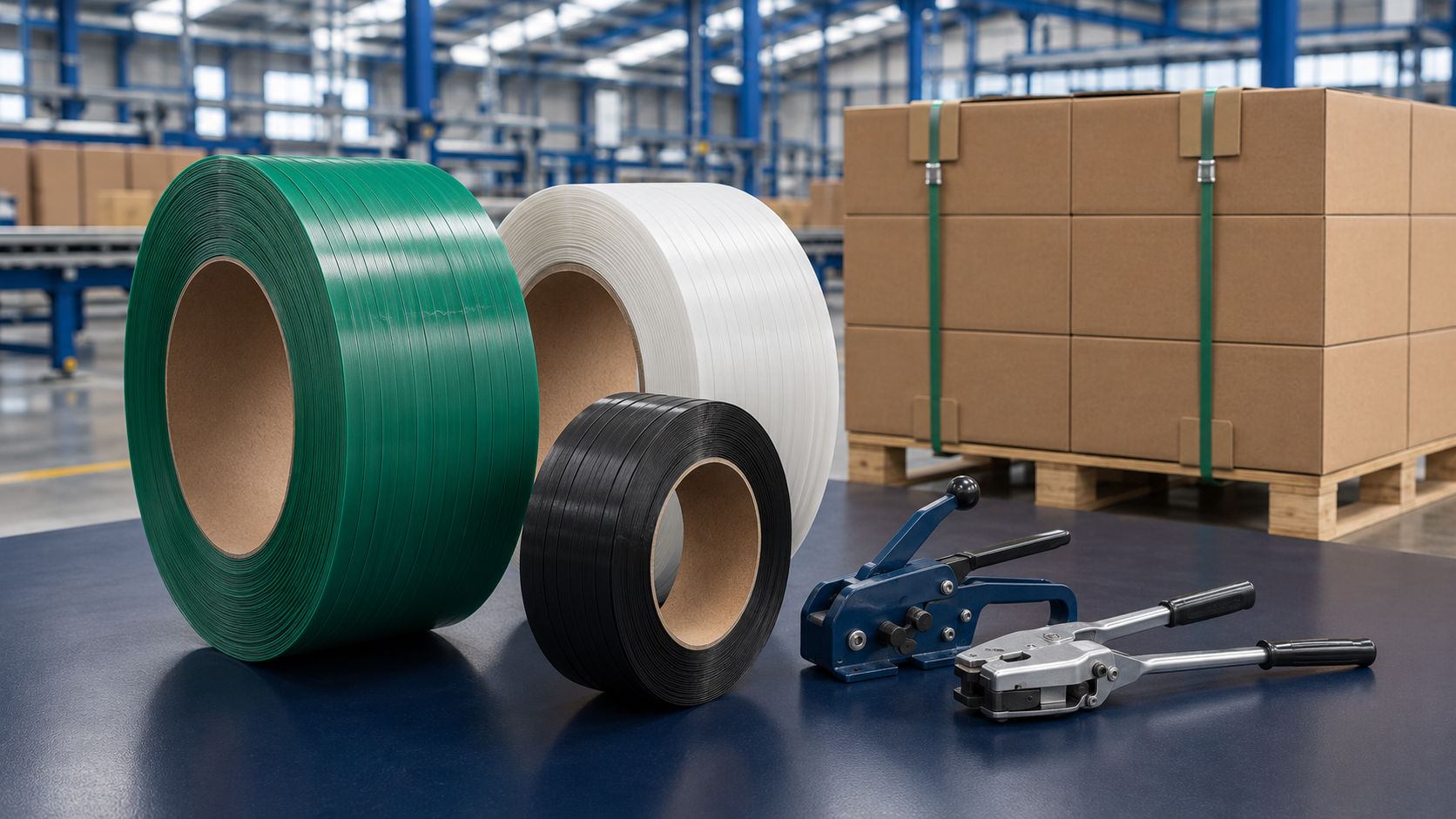
Plastic strapping (strap band) is an industrial binding material made from polymer raw material and supplied on rolls. It secures pallets, boxes, bales, or profile packages with circumferential compression, preventing them from coming apart during shipment.
When applied correctly, plastic strapping lowers transit-related damage rates, costs, and losses. By keeping products stable and orderly, it creates safety for both carriers and workers. For this reason, strapping is not just a warehouse detail but a quality step that touches brand perception.
Types of Plastic Strapping
Plastic straps are produced from different raw materials based on the weight of the load and the intended use:
- PP (polypropylene) strapping: An economical solution for binding boxes, packages, and light/medium loads. It is ideal for e-commerce boxes, warehouse shipments, and fast packing on production lines.
- PET (polyester) strapping: Offers higher strength. It holds its tension and resists shrinking and loosening, making it an economical alternative to steel for heavy and medium palletized shipments.
- Comparison with steel strapping: Steel strapping is preferred for very heavy and hot loads, but it is prone to rust, is heavy, and is hard to use. Plastic and polyester straps stand out with their rust-, dust-, and sun-resistant structures that return to shape after stretching and are recyclable.
Sizes and Machine Compatibility
Plastic straps are produced in various widths. The most common sizes are 9, 12, 13, 16, and 19 mm, with 12 mm being the standard choice in many operations for its balance of cost, strength, and ease of use. While 9 mm provides speed and economy for light packages, wider sections are used for heavy pallets.
Machine compatibility is critical in size selection. If your strapping machine or hand tool supports 12-16 mm, choosing a 19 mm strap will not be efficient. Plastic straps can be applied with semi-automatic and fully automatic strapping machines or with hand-held tensioners. The ends are joined by a heat weld on a machine and by a clip or metal buckle in manual application.
Applications
Plastic strapping is used in nearly every sector that ships palletized and packaged goods:
- Logistics and e-commerce: Securing box and pallet groups for shipment.
- Appliances and glass: Holding bulky and fragile products together.
- Wood and timber: Bundling long parts and boards.
- Construction and metallurgy: Binding heavy profile and material groups.
- Printing and food: Orderly dispatch preparation of packages and bales.
- Automotive and furniture: Palletized shipment of spare parts and modules.
For example, in a fast-dispatch e-commerce warehouse, a preset strap count and tension based on pallet type raise the damage-free delivery rate while reducing operator error.
How to Choose the Right Plastic Strapping
When selecting the best plastic strapping for your operation, weigh these criteria:
- Load type: Choose PP for light/medium loads and PET for heavy palletized shipments.
- Do not look at weight alone: Load instability, pallet height, vibration, and sharp corners also determine the binding need.
- Machine support: Choose your strap width according to the range your machine or hand tool supports.
- Storage duration: Pallets that will wait a long time need a strap that keeps its shape and does not lose tension.
- Ambient conditions: Moisture, temperature, and UV exposure affect consumable life, so choose the section and type accordingly.
By determining the right type and size, you can lower your consumable costs and improve your shipment security at the same time. Ekas Plastik Ambalaj offers the solution best suited to your operation with its PP and PET plastic strapping options. To identify the best strap for your shipments, explore our products and send us your quote request.