
What Is a Big Bag (FIBC)? Types and How to Choose
Moving 1,000 kg of cement in forty separate 25 kg sacks means forty fill cycles and forty handling operations. Do the same job with a single big bag and it drops to one fill and one lift. That efficiency is exactly why big bags have become so widespread in bulk logistics. In this guide, you will learn what a big bag is, the types available, their safety ratings, and how to choose the right model for your operation.
What Is a Big Bag?
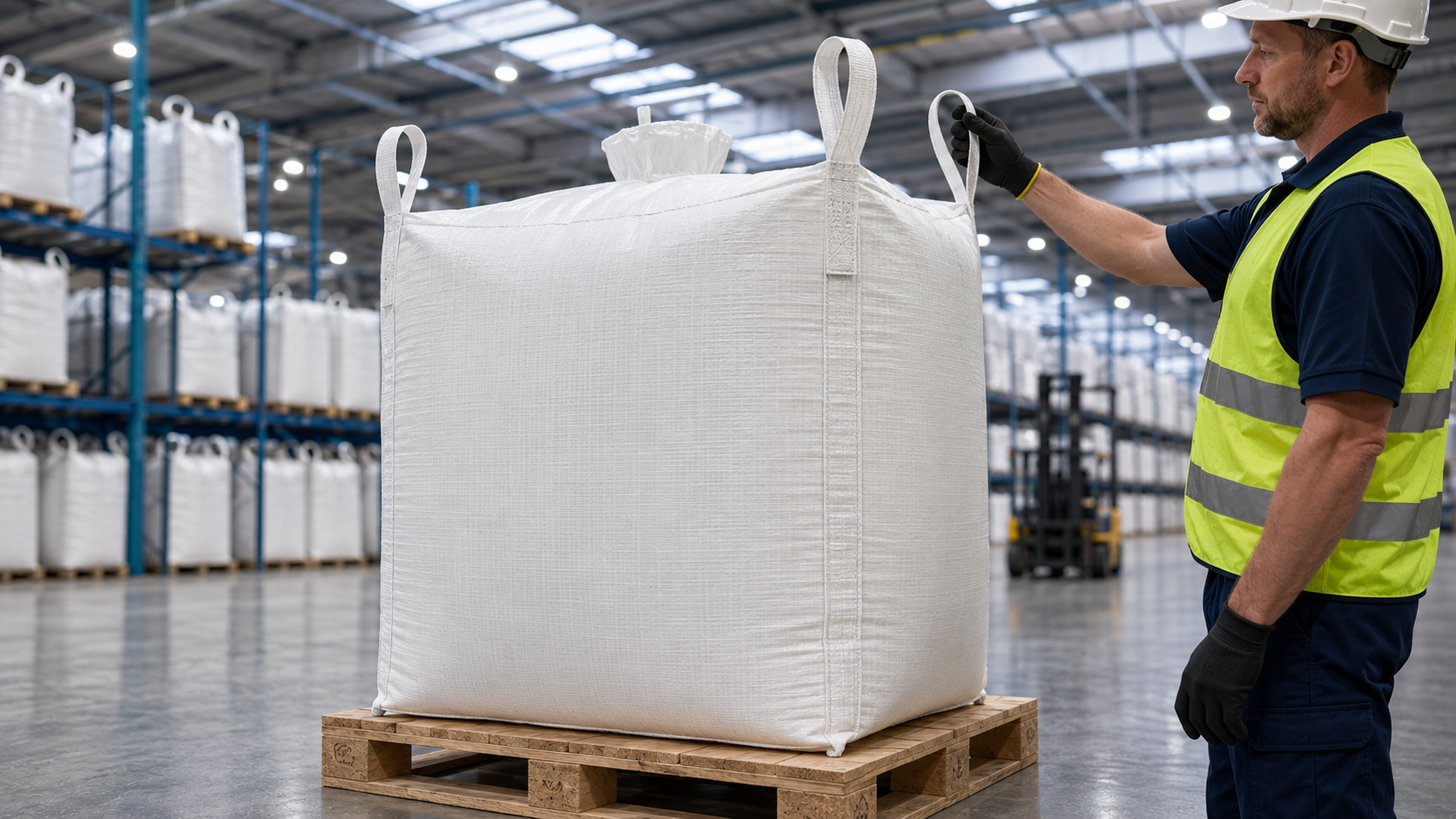
A big bag, known internationally as an FIBC (Flexible Intermediate Bulk Container), is a large-volume transport container made from high-strength woven polypropylene (PP) yarns. It usually offers a load capacity between 200 kg and 2,000 kg.
Thanks to the loops at its four corners, a big bag is easily lifted with a forklift or crane. Standard dimensions are mostly around 90×90×120 cm or 95×95×115 cm. This structure allows bulk material to be filled quickly and shipped safely.
Types of Big Bags
Big bags vary by both construction and intended use. The main construction types are:
- U-panel big bag: Two side panels joined to a single “U”-shaped base; this is the most common and economical model.
- Four-panel big bag: Sewn from four separate panels; its square form and upright stance improve stacking efficiency.
- Circular (tubular) big bag: Woven on a circular loom with no vertical body seams, which reduces the risk of sifting and leakage.
- Baffle / Q-Bag: Internal panels sewn into the corners prevent bulging and make better use of warehouse and truck space.
By intended use, models include: top-open/bottom-closed, top-spout (fill), double-spout (fill and discharge), vented, food-grade, and UN-certified (class 13H) big bags for dangerous goods.
Safety Factor and Load Capacity
The two most critical values in choosing a big bag are SWL (Safe Working Load) and SF (Safety Factor). SWL is the maximum weight the bag can safely carry.
The safety factor shows how many times that load the bag can withstand:
- 5:1 safety factor: Standard for single-use (one-trip) big bags.
- 6:1 safety factor: Required for multi-use models, which can be reused 5-6 times under proper conditions.
Quality big bags are produced with panels and seams that comply with the EN ISO 21898 standard, and they must offer adequate UV resistance. Choosing the wrong safety factor directly increases the risk of workplace accidents and product loss.
Applications
Big bags are a standard solution in nearly every sector that moves bulk loads:
- Construction: Transporting and on-site storage of cement, sand, aggregate, and concrete admixtures.
- Agriculture: Bulk shipment of grain, feed, fertilizer, and seed.
- Chemicals: Safe handling of chemicals in granule, powder, and pellet form.
- Food: Food-grade, hygienic models for products such as flour, sugar, and salt.
- Mining: Usually 1,500-2,000 kg capacity bags for heavy and abrasive materials.
- Recycling and waste management: Safe collection and transport of industrial waste.
Big bags are especially efficient in exports. For example, on a grain shipment sent by an agricultural cooperative through the Port of Mersin, a single big bag does the work of roughly 200-300 boxes, shortening handling time.
How to Choose the Right Big Bag
When selecting the best big bag for your operation, weigh these criteria:
- Material to be carried: Choose a laminated, lined, or vented model based on whether the product is dusty, granular, or moist.
- Load and safety factor: Set the SWL to your load; choose a 6:1 model if you plan to reuse the bag.
- Construction type: Baffle/Q-Bag suits stacking efficiency, while a circular model suits products sensitive to sifting.
- Certification needs: Food requires virgin raw material; dangerous goods require a UN-certified big bag.
- Discharge method: Bottom-spout models speed up discharge and save labor with products like sand and gravel.
By determining the right type and safety rating, you can lower your logistics costs and maximize your shipment security at the same time. Ekas Plastik Ambalaj offers durable, standards-compliant solutions with its range of big bags produced for the needs of different sectors. To identify the best model for your load, explore our products and send us your quote request.