
Container Dunnage Bags: The Professional Polypropylene Cargo Safety Solution
Industry data shows that roughly two-thirds of cargo damage claims stem from poor packing and inadequate load securing . Container dunnage bags are the most practical and economical solution developed to eliminate this risk. Also known as dunnage air bags, these products fill the voids inside containers, trucks, and railcars; they prevent loads from shifting, tipping over, and colliding with one another.
In this article you will find:
- How polypropylene dunnage bags work and the benefits they deliver
- The Atlantik Dunnage level range and a selection guide for your cargo
- The correct inflation and usage technique in 4 steps
What Is a Container Dunnage Bag?
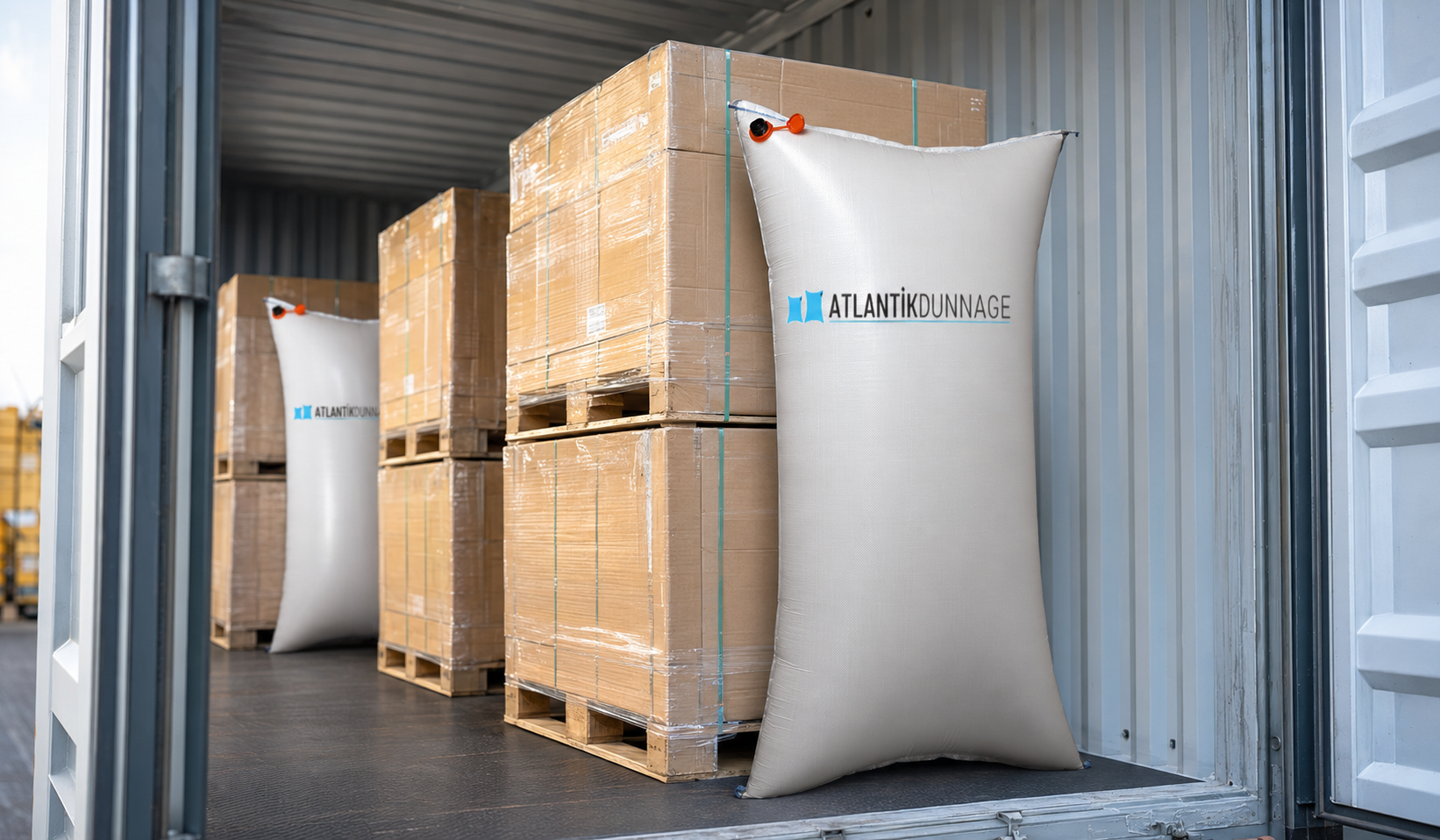
A container dunnage bag is a professional cargo securing device that you place in the voids between pallets and container walls, then inflate with air to stabilize loads during transit. The working principle is simple, yet the effect is powerful: the inflated bag completely fills the void, braces the load against the container walls or neighboring pallets, and absorbs the shocks and vibrations that occur along the route.
At Atlantik Dunnage, we manufacture our products from laminated polypropylene (PP) fabric. The lamination process reinforces the polypropylene fabric; as a result, it withstands tons of pressure and remains completely unaffected by water or humidity. This property is critical on ocean voyages that last for weeks. While paper-based alternatives lose strength in humid conditions, a polypropylene dunnage bag retains its structure and holding power.
Benefits of Polypropylene Dunnage Bags
Traditional securing methods such as wooden blocking and bracing are both labor-intensive and costly. They are also single-use and demand significant manpower. Polypropylene dunnage bags, by contrast, offer the following advantages:
- Dramatically reduce damage: Filling the voids between pallets with dunnage air bags can cut damage claims by up to 80% .
- Improve road safety: According to European Commission data, up to 25% of truck-related accidents are attributable to inadequate cargo securing. Proper securing protects not only the load but also the driver and other road users.
- Full resistance to water and moisture: Laminated PP fabric performs without loss even on transoceanic shipments.
- Reusable: A valve that allows fast inflation and deflation lets you use the same bag across multiple shipments.
- Lightweight and practical: Deflated bags take up minimal space, add no meaningful weight to the vehicle, and inflate within seconds.
- Environmentally friendly: Recyclable material eliminates single-use wood and foam waste.
For sensitive cargo such as electronics, furniture, glass, beverages, appliances, and machine parts, these benefits translate directly into fewer returns, fewer insurance claims, and happier customers.
Atlantik Dunnage Levels: Which One for Which Load?
Every shipment has different dynamics. Sudden braking on the road, wave impacts at sea, and railcar jolts on rail each apply different forces to your cargo. The CTU Code published by the IMO also requires cargo transport units to be secured in a manner appropriate to the transport mode. That is why we grade our polypropylene bags by transport mode:
| Level | Application | Typical Load |
|---|---|---|
| Level 0-1 | Road transport (trucks, trailers), Ocean container shipping | Palletized loads up to 3-4 tons |
| Level 2 | Ocean container shipping | Export cargo needing protection against wave impacts |
| Level 3 | Ocean + rail (containers and railcars) | Loads exposed to rolling motion and braking forces |
| Level 4 | Heavy industrial cargo | Construction materials, steel, timber, heavy rolls |
For example, the outer shell of our Level 1 bags consists of 65+25 g laminated polypropylene and withstands 8 PSI of impact pressure. For the right level and size based on your load weight, transport mode, and void dimensions, the Atlantik Dunnage expert team provides free support.
Correct Use: Inflation in 4 Steps
Correct application is essential to get maximum performance from a polypropylene bag. A poorly positioned or over-inflated bag reduces protective performance. Follow these steps:
- Step 1: Load the pallets and measure the remaining void between them. Choose the bag size to match this void; the gap must fall within the bag’s working range.
- Step 2: Center the bag between the pallets, leaving about 15 cm of clearance at both the top and the bottom. Use protective liners against sharp-edged loads.
- Step 3: Always inflate inside the vehicle or container. Feed the air in a controlled way with a compressor-fed inflation gun.
- Step 4: Adjust the fill level to the remaining gap. The bag must fill the void completely but must not be over-inflated.
On arrival, open the valve to deflate the bag within seconds, then fold it away for the next shipment.
Conclusion: Deliver Your Cargo Damage-Free
Container dunnage bags are a low-cost, reusable, and environmentally friendly cargo securing solution that dramatically reduces shipping damage. Their laminated polypropylene construction provides full moisture protection, withstands tons of pressure, and comes in level options suited to every transport mode. Choose the right level and apply it correctly, and your cargo stays safe even on the toughest routes.
Secure your export shipments today. For polypropylene solutions tailored to your cargo and a price quote, contact Atlantik Dunnage.